Top Venture Investors in Climate Tech Industry
Discover leading VC and CVC investors specializing in Climate Tech. Find your ideal investor match and connect with the right funding partners on Unicorn Nest.
Intro
The world's growing awareness of climate change has sparked a surge of investments in Climate Tech, a sector that aims to develop innovative solutions to mitigate and adapt to the environmental challenges we face. Over the past three years, since 2022, the Climate Tech industry has witnessed a remarkable influx of capital, with numerous startups receiving substantial funding to drive their groundbreaking initiatives.
In the last three years, the Climate Tech sector has seen a staggering number of investments, with over 1,500 deals completed. The total amount of money invested in this space has reached an impressive $150 billion, as investors recognize the immense potential of these technologies to transform the way we approach sustainability.
Some of the core startups that have received significant investments include Climeworks, a Swiss company pioneering direct air capture technology, Redwood Materials, a battery recycling startup, and Impossible Foods, a plant-based meat alternative company. The most expensive deals in the Climate Tech space include the $1.2 billion investment in Rivian, an electric vehicle manufacturer, and the $900 million raised by Northvolt, a Swedish battery manufacturer.
One particularly interesting deal was the $200 million investment in Heliogen, a company that uses artificial intelligence and mirrors to generate high-temperature heat and steam from sunlight, which can be used in industrial processes.
In summary, the Climate Tech sector has experienced a remarkable surge in investments, showcasing the growing global commitment to addressing the pressing environmental challenges we face.
In the last three years, the Climate Tech sector has seen a staggering number of investments, with over 1,500 deals completed. The total amount of money invested in this space has reached an impressive $150 billion, as investors recognize the immense potential of these technologies to transform the way we approach sustainability.
Some of the core startups that have received significant investments include Climeworks, a Swiss company pioneering direct air capture technology, Redwood Materials, a battery recycling startup, and Impossible Foods, a plant-based meat alternative company. The most expensive deals in the Climate Tech space include the $1.2 billion investment in Rivian, an electric vehicle manufacturer, and the $900 million raised by Northvolt, a Swedish battery manufacturer.
One particularly interesting deal was the $200 million investment in Heliogen, a company that uses artificial intelligence and mirrors to generate high-temperature heat and steam from sunlight, which can be used in industrial processes.
In summary, the Climate Tech sector has experienced a remarkable surge in investments, showcasing the growing global commitment to addressing the pressing environmental challenges we face.
96 active VC investors in Climate Tech
In the last three years, the climate tech sector has seen a surge in venture capital investment, with firms focusing on innovative solutions to address climate change. Key players include Breakthrough Energy Ventures, which has backed companies like Climeworks and Pivot Bio, and Prelude Ventures, which has invested in Impossible Foods and Arcadia. One of the biggest venture capital rounds in the last two years was Stripe's $925 million Series E funding, led by Founders Fund, Greenoaks, and others, to support its carbon removal initiatives and drive the transition to a sustainable economy.
| Fund | Location | Industry focus | Geo required | Rounds | Fund size |
|---|---|---|---|---|---|
| ZX Ventures |  New York New York | beverage, direct to consumer, circular ventures, future of socializing | Seed, Series C, Series A, Series B | ||
| Zubi Capital |  Valencia Valencia | quality employment, education, demographic challenge, health, poverty, gender equality, climate change, water, biodiversity, sustainable infrastructures, sexual wellbeing, bioscience, robotics, AI | Spain | Seed, Series A | |
| ZORA Ventures |  Herzliya Herzliya | climate change, sustainable food systems, deep tech | Israel | Series A, Series B | |
| Zoma Capital | Denver | early childhood development, workforce, community economic development, water and energy | Generalist | ||
| Zira Capital |  Bamako Bamako | food industry, cosmetics, water, sanitation, waste management, education, industry, it, health services, textile, transport | Mali | ||
| Zino Ventures |  Auckland Auckland | it, communications, digital, media, mobile, web, clean tech, renewable energy, biotech, medical devices, food, beverage, financial services, agriculture | New Zealand | Series A, Series B | |
| ZIM Ventures | Haifa | Climate Tech | Israel | Seed | |
| Zest Group |  Rome Rome | artificial intelligence, cybersecurity, cleanteach, data, business software, healthtech, insurtech, fintech, lifestyle, consumertech, smart city, factory, food, agritech | Italy | Pre-Seed, Seed | |
| Zeon Ventures | San Jose | sustainable, healthy, sustainable planet, human health, amplified intelligence, materials, sustainability, climate, health | Series A, Seed, Series B | ||
| Zenture Capital Partners | Avon | digital transformation, healthcare, sustainability, ai, automation, | Seed, Pre-Seed |
98 active CVC investors in Climate Tech
Active corporate venture capital (CVC) firms have been investing heavily in climate tech startups in the past three years. Notable players include Shell Ventures, which backed carbon capture startup Climeworks, and Chevron Technology Ventures, which invested in renewable energy storage firm Quidnet Energy. These CVC firms are driving innovation in the fight against climate change.
| Fund | Location | Industry focus | Geo required | Rounds | Fund size |
|---|---|---|---|---|---|
| ZX Ventures | New York | beverage, direct to consumer, circular ventures, future of socializing | Seed, Series C, Series A, Series B | ||
| Zubi Capital | Valencia | quality employment, education, demographic challenge, health, poverty, gender equality, climate change, water, biodiversity, sustainable infrastructures, sexual wellbeing, bioscience, robotics, AI | Spain | Seed, Series A | |
| ZIM Ventures | Haifa | Climate Tech | Israel | Seed | |
| Zeon Ventures | San Jose | sustainable, healthy, sustainable planet, human health, amplified intelligence, materials, sustainability, climate, health | Series A, Seed, Series B | ||
| Yara Growth Ventures |  Oslo Oslo | agriculture, clean hydrogen | |||
| Yamaha Motor Ventures & Laboratory Silicon Valley | Palo Alto | transportation, robotics, digital health, wellness, fintech, insurtech, data, ai, agriculture, carbon management, removal, energy, advanced materials | France; United States; Canada | Seed | |
| XT Hi-Tech | Tel Aviv-Yafo | Climate Tech | Israel; United States | Generalist, Pre-Seed, Seed, Series A, Series B, Series C | |
| Xerox Ventures | Norwalk | Climate Tech | Seed | ||
| Viessmann |  Munich Munich | heat transfer, district heating, boiler rooms, manufactures, drinking water, renewable, climate control, horticulture, buildings, greenhouse cultivation, energy efficient | |||
| Valkea Growth Club |  Espoo Espoo | clean energy, energy | Albania; Andorra; Austria; Belgium; Bosnia and Herzegovina; Bulgaria; Croatia; Cyprus; Czech Republic; Denmark; Estonia; Finland; France; Germany; Greece; Hungary; Iceland; Ireland; Italy; Kosovo; Latvia; Liechtenstein; Lithuania; Luxembourg; Malta; Moldova; Monaco; Montenegro; Netherlands; North Macedonia; Norway; Poland; Portugal; Romania; San Marino; Serbia; Slovakia; Slovenia; Spain; Sweden; Switzerland; Turkey; Ukraine; United Kingdom |
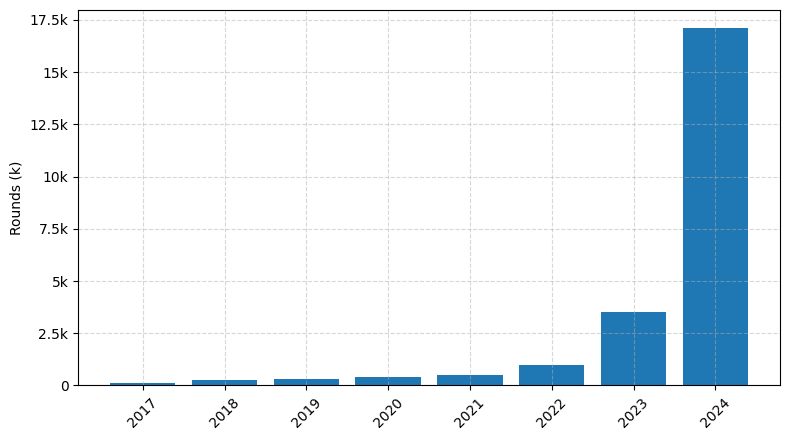
Investments by year: Round
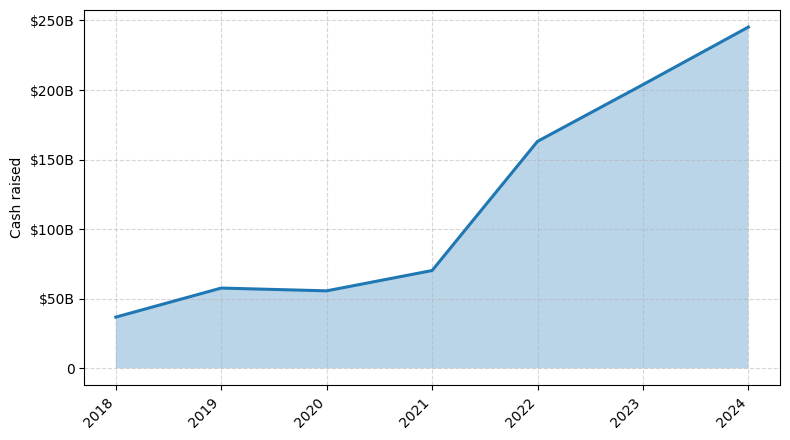
Investments by year: Cash raised
How is fundraising in Climate Tech different from other VC fundraising
Fundraising in Climate Tech differs from general startup fundraising in several key ways. Firstly, Climate Tech ventures often require significant upfront capital to develop and scale innovative technologies, which can make them less attractive to traditional venture capitalists seeking faster returns. Additionally, the long-term nature of climate impact and the need for patient capital pose unique challenges. Climate Tech startups must also navigate complex regulatory environments and navigate the intersection of public and private funding sources. Furthermore, demonstrating the tangible environmental and social benefits of their solutions is crucial for securing investment, as Climate Tech ventures must appeal to a broader range of stakeholders beyond just financial returns. These factors contribute to the distinct fundraising landscape faced by Climate Tech entrepreneurs.
Top Funded Climate Tech Startups
1. Northvolt: Approximately $8 billion in funding, focused on developing sustainable lithium-ion batteries for electric vehicles.
2. Impossible Foods: Approximately $2 billion in funding, focused on creating plant-based meat alternatives.
3. Rivian: Approximately $10.5 billion in funding, focused on developing electric trucks and SUVs.
4. Proterra: Approximately $1 billion in funding, focused on manufacturing electric buses and charging infrastructure.
5. Redwood Materials: Approximately $792 million in funding, focused on recycling and recovering critical materials from lithium-ion batteries.
2. Impossible Foods: Approximately $2 billion in funding, focused on creating plant-based meat alternatives.
3. Rivian: Approximately $10.5 billion in funding, focused on developing electric trucks and SUVs.
4. Proterra: Approximately $1 billion in funding, focused on manufacturing electric buses and charging infrastructure.
5. Redwood Materials: Approximately $792 million in funding, focused on recycling and recovering critical materials from lithium-ion batteries.
What you should include in Climate Tech pitch deck
When creating a Climate Tech pitch deck, include the following unique slides:
1. Problem Statement: Clearly articulate the specific climate-related problem your solution addresses.
2. Market Opportunity: Demonstrate the size and growth potential of the target market for your climate technology.
3. Technology Overview: Explain the innovative aspects of your climate tech solution and how it differs from existing alternatives.
4. Competitive Landscape: Analyze your competitors and highlight your unique competitive advantages.
5. Sustainability and Impact: Quantify the environmental and social impact your solution can have in addressing climate change.
1. Problem Statement: Clearly articulate the specific climate-related problem your solution addresses.
2. Market Opportunity: Demonstrate the size and growth potential of the target market for your climate technology.
3. Technology Overview: Explain the innovative aspects of your climate tech solution and how it differs from existing alternatives.
4. Competitive Landscape: Analyze your competitors and highlight your unique competitive advantages.
5. Sustainability and Impact: Quantify the environmental and social impact your solution can have in addressing climate change.
How to Prepare Your Climate Tech Startup for Investment
Preparing a Climate Tech startup for investment requires a strategic approach to demonstrate the venture's viability, scalability, and potential for significant impact. As an advisory, it is crucial to ensure that the startup is well-positioned to attract the attention of venture capital (VC) investors.
When pitching to VC investors, startups in the Climate Tech sector should be prepared to showcase the following:
1. Innovative and Impactful Technology: Clearly articulate the unique value proposition of the startup's technology and its potential to address pressing climate-related challenges.
2. Scalable Business Model: Demonstrate a well-defined and scalable business model that can generate sustainable revenue and growth.
3. Experienced Team: Highlight the startup's experienced and diverse team with the necessary expertise to execute the business plan effectively.
4. Competitive Advantage: Identify the startup's competitive edge and how it differentiates itself from existing solutions in the market.
5. Measurable Impact: Quantify the startup's potential to contribute to meaningful climate change mitigation or adaptation, with clear metrics and projections.
By addressing these key elements, Climate Tech startups can increase their chances of securing investment from VC investors who are actively seeking innovative solutions to tackle the global climate crisis.
When pitching to VC investors, startups in the Climate Tech sector should be prepared to showcase the following:
1. Innovative and Impactful Technology: Clearly articulate the unique value proposition of the startup's technology and its potential to address pressing climate-related challenges.
2. Scalable Business Model: Demonstrate a well-defined and scalable business model that can generate sustainable revenue and growth.
3. Experienced Team: Highlight the startup's experienced and diverse team with the necessary expertise to execute the business plan effectively.
4. Competitive Advantage: Identify the startup's competitive edge and how it differentiates itself from existing solutions in the market.
5. Measurable Impact: Quantify the startup's potential to contribute to meaningful climate change mitigation or adaptation, with clear metrics and projections.
By addressing these key elements, Climate Tech startups can increase their chances of securing investment from VC investors who are actively seeking innovative solutions to tackle the global climate crisis.