Top Venture Investors in Edtech Industry
Discover leading VC and CVC investors specializing in Edtech. Find your ideal investor match and connect with the right funding partners on Unicorn Nest.
Intro
The education technology (Edtech) sector has witnessed a surge in investments over the past three years, reflecting the growing demand for innovative digital solutions in the education landscape. Since 2022, the Edtech industry has seen a significant influx of capital, with numerous startups receiving substantial funding to drive their innovative initiatives.
In the last three years, the Edtech sector has witnessed over 1,500 investments, with a total investment value exceeding $50 billion. Some of the core startups that have received substantial investments include Coursera, Byju's, and Udemy, each securing multi-million-dollar deals. The most expensive Edtech deals during this period include Byju's $1.2 billion funding round and Coursera's $130 million Series F round. One particularly interesting deal was Duolingo's $35 million investment, which highlighted the growing demand for language-learning platforms.
In summary, the Edtech industry has experienced a remarkable investment boom, with billions of dollars flowing into the sector to support the development of cutting-edge educational technologies and solutions.
In the last three years, the Edtech sector has witnessed over 1,500 investments, with a total investment value exceeding $50 billion. Some of the core startups that have received substantial investments include Coursera, Byju's, and Udemy, each securing multi-million-dollar deals. The most expensive Edtech deals during this period include Byju's $1.2 billion funding round and Coursera's $130 million Series F round. One particularly interesting deal was Duolingo's $35 million investment, which highlighted the growing demand for language-learning platforms.
In summary, the Edtech industry has experienced a remarkable investment boom, with billions of dollars flowing into the sector to support the development of cutting-edge educational technologies and solutions.
98 active VC investors in Edtech
In the last three years, the EdTech sector has seen a surge of investment from active venture capital firms. Key players like Andreessen Horowitz, Sequoia Capital, and Accel have been at the forefront, backing innovative EdTech startups. One notable example is the $250 million Series E round raised by Coursera in 2020, which was one of the largest EdTech funding rounds in recent years. This investment underscores the growing interest and confidence in the potential of technology-driven education solutions to transform the learning landscape.
| Fund | Location | Industry focus | Geo required | Rounds | Fund size |
|---|---|---|---|---|---|
| Z Venture Capital |  Tokyo Tokyo | Edtech | Brunei; Cambodia; East Timor; Indonesia; Laos; Malaysia; Myanmar; Philippines; Singapore; Thailand; Vietnam; Japan; South Korea; United States | Seed | |
| Zubi Capital |  Valencia Valencia | quality employment, education, demographic challenge, health, poverty, gender equality, climate change, water, biodiversity, sustainable infrastructures, sexual wellbeing, bioscience, robotics, AI | Spain | Seed, Series A | |
| Zoma Capital |  Denver Denver | early childhood development, workforce, community economic development, water and energy | Generalist | ||
| Zira Capital |  Bamako Bamako | food industry, cosmetics, water, sanitation, waste management, education, industry, it, health services, textile, transport | Mali | ||
| Zeta Alpha |  Vienna Vienna | Edtech | Seed | ||
| Zero-One Capital | San Francisco | Edtech | |||
| Zero Gravity Capital |  Bratislava Bratislava | e-commerce, robotics, fintech, edtech, data analytics, AI, beauty tech, streaming platform | Slovakia | Series A, Series B, Seed | |
| Zen Girişim |  Istanbul Istanbul | Edtech | |||
| Zelkova Ventures | Miami | Edtech | Generalist | Seed | USD 15000000 |
| Zee Prime Capital | Bratislava | programmable assets, collaborative intelligence | United Kingdom | Seed |
63 active CVC investors in Edtech
Active corporate venture capital (CVC) firms have been increasingly investing in the EdTech sector over the past three years. Notable players include Pearson Ventures, which backed Labster's virtual lab simulations, and Google's GV, which invested in Coursera's online learning platform. These CVC firms are driving innovation and shaping the future of education technology.
| Fund | Location | Industry focus | Geo required | Rounds | Fund size |
|---|---|---|---|---|---|
| Z Venture Capital | Tokyo | Edtech | Brunei; Cambodia; East Timor; Indonesia; Laos; Malaysia; Myanmar; Philippines; Singapore; Thailand; Vietnam; Japan; South Korea; United States | Seed | |
| Zubi Capital | Valencia | quality employment, education, demographic challenge, health, poverty, gender equality, climate change, water, biodiversity, sustainable infrastructures, sexual wellbeing, bioscience, robotics, AI | Spain | Seed, Series A | |
| Wormhole Capital | New York | Edtech | Series A, Seed, Series B, Series C | ||
| Wayra UK |  London London | fintech, Cloud/Infrastructure, Telecommunications, hardware, Industry, Consumer Goods, Smart Cities, Mobility, E-commerce, Legal, Networks, Construction, Engineering, Cloud services, Education, Customer Service, Security, Entertainment, Analytics, Marketing, AI, Social Networks, Tourism, FinTech, Healthcare, Transport, Media, Financial, Electronics | United Kingdom, United States | Seed Round, Series A, Series B, Pre Seed Round | |
| Washington University in St. Louis | St. Louis | agriculture, apparel, banking, beauty, biotech, chemicals, communication, construction, consulting, crypto, ecommerce, education, electronics, energy, engineering, entertainment, fashion, fintech, food, beverage, gaming, healthcare, manufacturing, media, medical service, medicine, mobile app, outdoor, retail, service, social media, software, software as service, technology, human resources | Generalist, Pre-Seed, Seed, Series A, Series B, Series C | ||
| Wamda Capital |  Dubai Dubai | industry, consumer, crypto, web3, ecommerce, education, fintech, food, healthcare, hr, talent, legal, mobility, logistics, real estate, retail, saas, enterprise software | Algeria; Bahrain; Egypt; Iraq; Israel; Jordan; Kuwait; Lebanon; Libya; Morocco; Oman; Qatar; Saudi Arabia; Tunisia; United Arab Emirates; Djibouti | Series B, Series A | USD 75000000 |
| TS Ventures Fond |  Belgrade Belgrade | ai, big data, b2b, enterprise, cloud, infrastructure, consumer, retail, developer tools, ecommerce, edtech, fintech, media, content, productivity | Seed, Series A, Pre-Seed, Series B | ||
| TMC Venture Fund | Houston | digital health, medical devices, therapeutics | Seed | USD 50000000 | |
| Stanford GSB Impact Fund | Stanford | education, energy and the environment, fintech, food, agriculture, justice, healthcare, urban development | Generalist; United States | Seed, Series A | |
| Sony Innovation Fund | Tokyo | Edtech | Generalist | Seed |
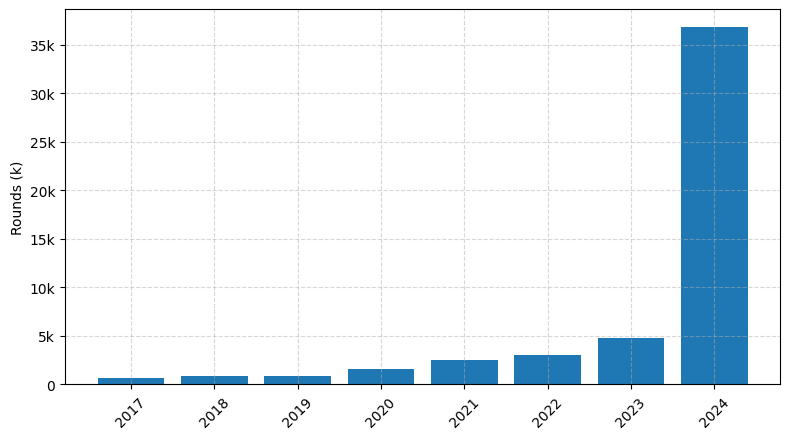
Investments by year: Round
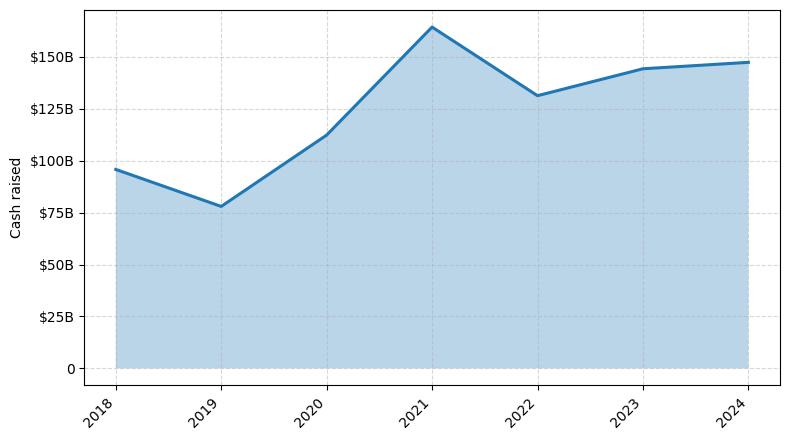
Investments by year: Cash raised
How is fundraising in Edtech different from other VC fundraising
Fundraising in the EdTech sector differs from general startup fundraising in several key ways. Firstly, EdTech companies often face unique challenges in demonstrating the efficacy and impact of their products, as they need to convince investors of their ability to improve educational outcomes. Additionally, the sales cycles in the education market can be significantly longer than in other industries, as schools and districts often have complex procurement processes. Furthermore, EdTech startups must navigate the complex regulatory landscape of the education sector, ensuring their products comply with various standards and requirements. These factors can make it more challenging for EdTech companies to attract investment compared to startups in other industries. Successful EdTech fundraising requires a deep understanding of the education market, a strong focus on demonstrating measurable impact, and a strategic approach to navigating the unique challenges of the sector.
Top Funded Edtech Startups
Here is a summary of the top-funded Edtech startups globally:
- Byju's: Approximately $5.7 billion in total funding, focused on K-12 online learning.
- Coursera: Approximately $443 million in total funding, focused on online higher education and professional courses.
- Udemy: Approximately $273 million in total funding, focused on online courses for individuals and enterprises.
- Yuanfudao: Approximately $2.2 billion in total funding, focused on K-12 online tutoring and educational apps.
- Duolingo: Approximately $183 million in total funding, focused on language learning.
- Byju's: Approximately $5.7 billion in total funding, focused on K-12 online learning.
- Coursera: Approximately $443 million in total funding, focused on online higher education and professional courses.
- Udemy: Approximately $273 million in total funding, focused on online courses for individuals and enterprises.
- Yuanfudao: Approximately $2.2 billion in total funding, focused on K-12 online tutoring and educational apps.
- Duolingo: Approximately $183 million in total funding, focused on language learning.
What you should include in Edtech pitch deck
When creating an EdTech pitch deck, it's essential to include the following unique slides:
1. Problem Statement: Clearly define the educational challenge or pain point your solution addresses.
2. Solution Overview: Explain how your EdTech product or service solves the identified problem.
3. Market Opportunity: Demonstrate the size and growth potential of the target market.
4. Competitive Advantage: Highlight the unique features or capabilities that set your solution apart from competitors.
5. Business Model: Outline your revenue streams, pricing strategy, and scalability.
6. Team and Expertise: Showcase the qualifications and experience of your key team members.
1. Problem Statement: Clearly define the educational challenge or pain point your solution addresses.
2. Solution Overview: Explain how your EdTech product or service solves the identified problem.
3. Market Opportunity: Demonstrate the size and growth potential of the target market.
4. Competitive Advantage: Highlight the unique features or capabilities that set your solution apart from competitors.
5. Business Model: Outline your revenue streams, pricing strategy, and scalability.
6. Team and Expertise: Showcase the qualifications and experience of your key team members.
How to Prepare Your Edtech Startup for Investment
Preparing an EdTech startup for investment requires a strategic approach to demonstrate the venture's viability and growth potential. As an advisory, it is crucial to ensure that the startup is well-positioned to attract the attention of venture capital (VC) investors.
When pitching to VC investors, startups should be prepared to showcase the following:
1. Clearly defined problem and solution: Articulate the specific educational challenge the startup aims to address and how its innovative solution effectively solves that problem.
2. Compelling market opportunity: Demonstrate a deep understanding of the target market, its size, growth potential, and the startup's ability to capture a significant share.
3. Differentiated technology and product: Highlight the unique features, functionalities, and competitive advantages of the EdTech solution, showcasing its technological superiority.
4. Experienced and capable team: Introduce the founding team and key personnel, emphasizing their relevant expertise, industry knowledge, and track record of success.
5. Scalable and sustainable business model: Outline a well-thought-out revenue generation strategy, financial projections, and a clear path to profitability and long-term growth.
By addressing these key elements in the pitch deck, EdTech startups can increase their chances of securing investment from discerning VC investors and accelerate their journey towards success.
When pitching to VC investors, startups should be prepared to showcase the following:
1. Clearly defined problem and solution: Articulate the specific educational challenge the startup aims to address and how its innovative solution effectively solves that problem.
2. Compelling market opportunity: Demonstrate a deep understanding of the target market, its size, growth potential, and the startup's ability to capture a significant share.
3. Differentiated technology and product: Highlight the unique features, functionalities, and competitive advantages of the EdTech solution, showcasing its technological superiority.
4. Experienced and capable team: Introduce the founding team and key personnel, emphasizing their relevant expertise, industry knowledge, and track record of success.
5. Scalable and sustainable business model: Outline a well-thought-out revenue generation strategy, financial projections, and a clear path to profitability and long-term growth.
By addressing these key elements in the pitch deck, EdTech startups can increase their chances of securing investment from discerning VC investors and accelerate their journey towards success.